Project context
Overview
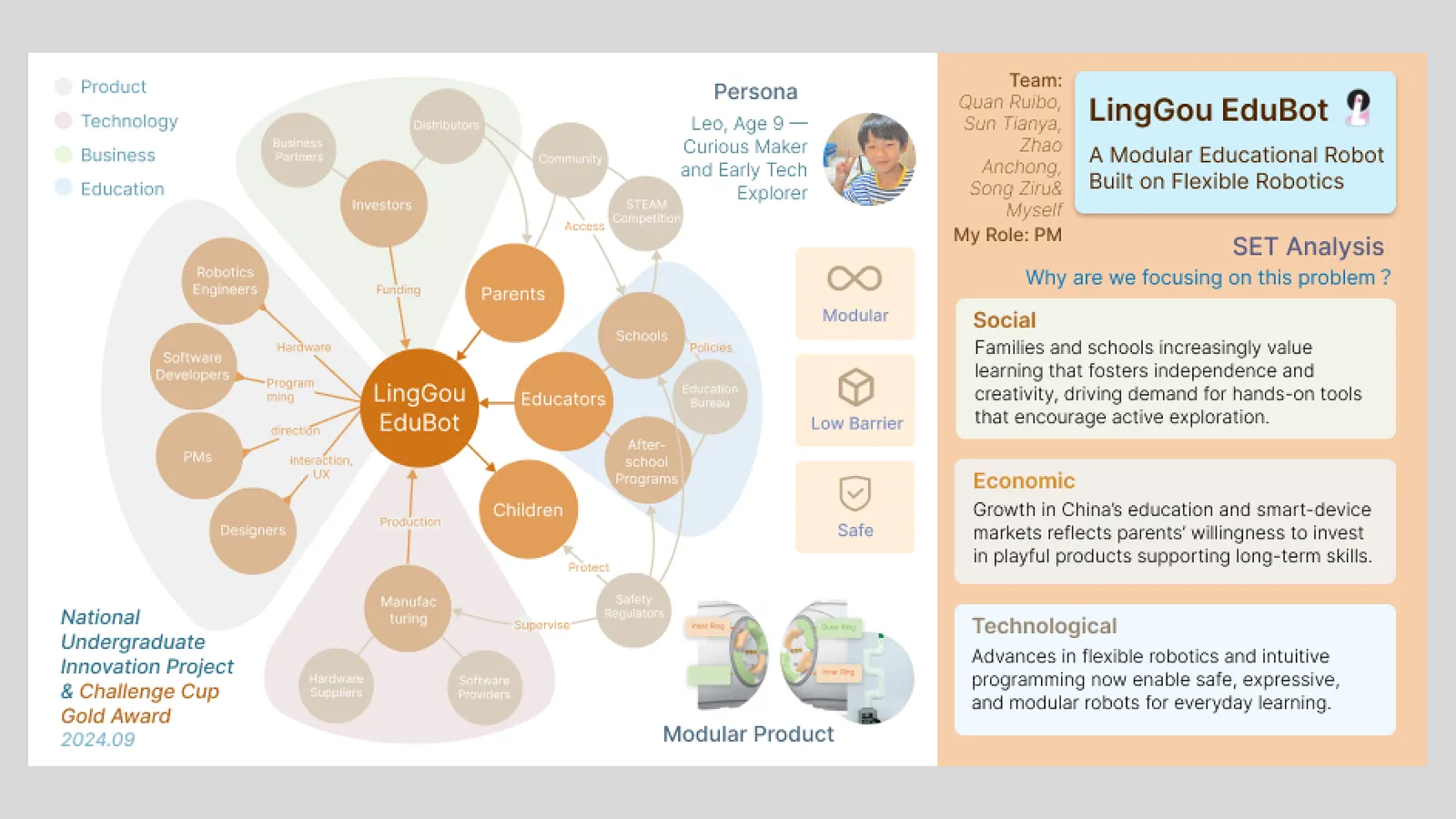
LingGou EduBot is a modular educational robot developed for hands-on STEAM learning at home and in school. The team combined flexible robotics, education expertise, and business strategy; I served as product manager and owned the path from opportunity framing to product definition.
The project focused on children aged 7–10 and proposed snap-fit modules with built-in power and communication, allowing expressive structures without wiring or technical setup.
Research direction
Key Insight
A questionnaire with 205 Beijing parents found strong interest in technology and robotics, while observation of a coding workshop showed a gap between enthusiasm and the rigidity of available learning tools. The primary users were children, but adoption depended equally on parents and educators.
The product had to balance three needs at once: creative independence for children, clear learning value for educators, and safety and trust for parents.
What shaped the work
Design Decisions
I positioned LingGou between simple robot toys and curriculum-heavy coding kits. Four principles guided the strategy: a low barrier to start, open-ended modularity, expressive feedback, and parent-approved safety.
Process
Modules connect physically without loose wiring or specialist setup.
Each part carries power and communication through the joint.
Children can build creatures and structures that visibly respond.
Content and feedback support exploration without turning play into a class.
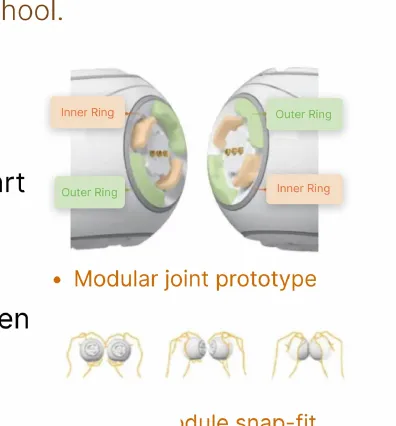
How it works
Prototype & Experience
The team aligned on a focused MVP and used a ROS development environment to explore the robot’s movement and modular configuration. The physical concept and product strategy were advanced together so the learning promise remained connected to engineering feasibility.
What changed
Outcome & Reflection
The project received 100,000 CNY in national innovation funding and a Gold Award at the 2024 Challenge Cup. More important for my practice, it showed how product language can connect technical constraints, educational value, and business adoption across disciplines.