Overview
Overview
What changes when a social platform organizes attention around discovery rather than the people a user follows? This research essay explores that question through Xiaohongshu’s Explore Feed, connecting interface evolution with visibility, social comparison, and audience management. It treats feed design as a cultural arrangement, not simply a way to display content.
Original coursework
From Following to Discovery: How Xiaohongshu’s Feed Redesign Reshaped Visibility, Comparison, and User Tagging Practices
Founded in 2013 as a platform for Chinese consumers to review products and share shopping experiences, Xiaohongshu (RedNote) expanded rapidly following a US$300 million investment from Alibaba Group and Tencent in 2018. Around this period, its “Notes Feed” shifted from a chronological, follower-based timeline to a personalized, algorithmic “Explore Feed,” placing discovery rather than social connection at the center of content circulation. This transition marked Xiaohongshu’s evolution from a community-oriented review platform into a recommendation-driven social media environment increasingly organized around algorithmic content distribution and aspirational lifestyle narratives (Zhou, 2023).
This article argues that the shift from following to discovery reshapes how participation and visibility are organized on Xiaohongshu, rather than simply altering interface design or content reach. By changing how visibility is produced and rewarded, the Explore Feed intensifies social comparison by repeatedly surfacing idealized versions of everyday life (Verduyn et al., 2020). As visibility becomes tied to algorithmic amplification rather than social relationships, evaluation shifts from peer-based recognition to abstract performance against platform-endorsed ideals of lifestyle, productivity, and self-presentation. At the same time, the loss of predictable audiences prompts users to develop adaptive strategies to manage exposure and unwanted attention. In particular, the tactical re-appropriation of tags functions as a form of everyday negotiation with the platform, enabling users to shape audience composition and construct smaller, more relatable micro-publics within a recommendation-driven system (Wan et al., 2025). Adopting a platform biography approach, this article examines the Explore Feed as a site where interface design and algorithmic distribution reorganize user visibility and participatory culture. Following Burgess and Baym’s (2022) approach to platform biography, the Explore Feed is treated here not as a static interface feature but as a historically situated site where technical design, cultural norms, and user practices intersect.
The Shift from Following to Discovery
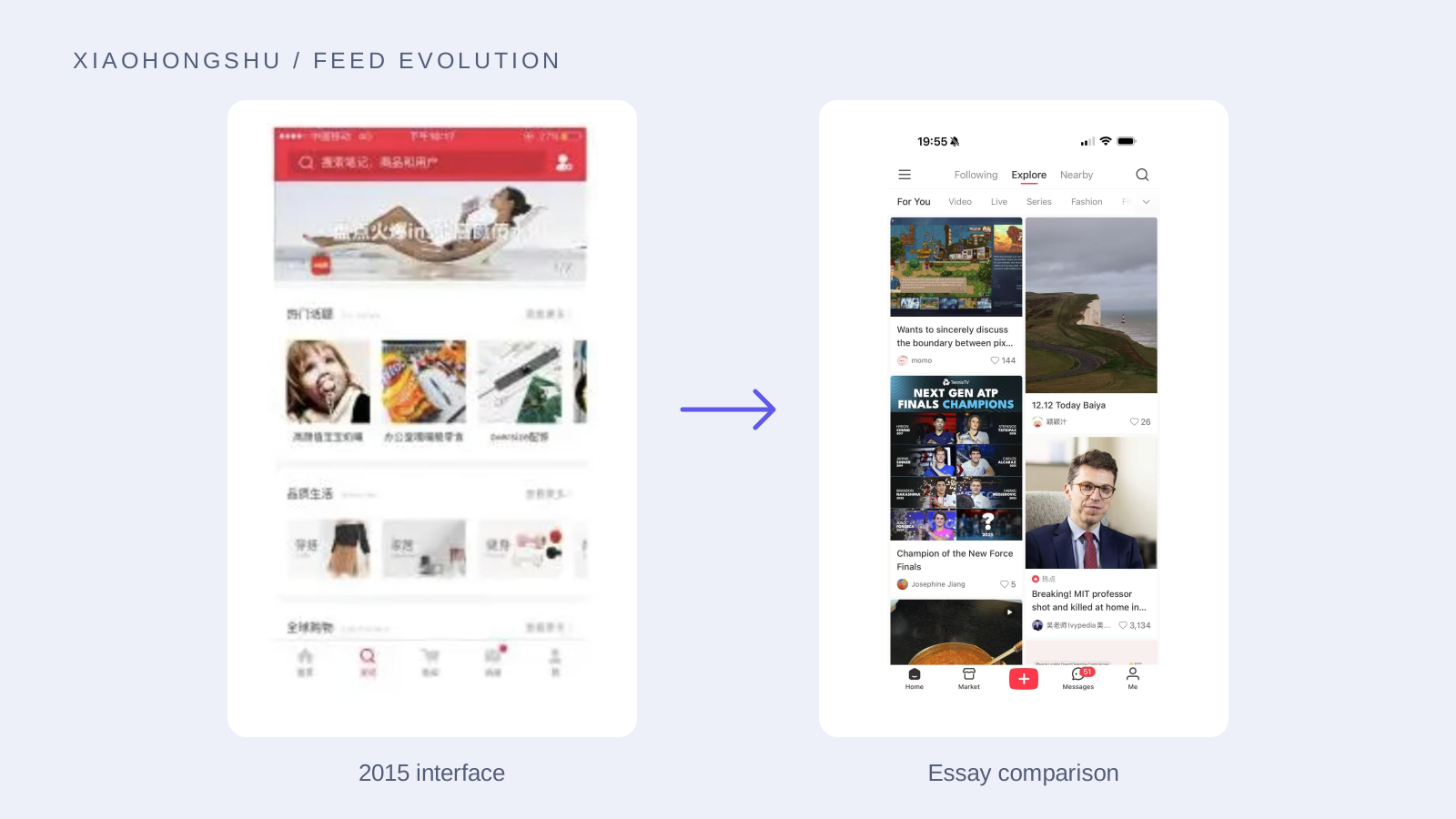
Xiaohongshu’s early growth was built on a clear product positioning: a UGC information platform where users could “discover good things from around the world” by sharing firsthand shopping experiences and detailed guides for overseas purchasing. A 2017 product analysis describes the platform’s initial use scenario as highly practical—young users unsure what to buy abroad relied on peer-generated shopping guides and “real buyer endorsement,” effectively translating offline shopping discovery into an online, community-based practice (LA, 2017). During this phase, Xiaohongshu largely operated as a UGC community for shopping tips: content was produced and circulated through interest-based communities, and visibility remained comparatively bounded. Even though the interface already included “Following” and “Discovery” buttons and the navigation bar (see Figure 1), the 2015 Explore page functioned more as categorized browsing than as a continuous recommendation stream, keeping audiences relatively predictable and contextually coherent.
A decisive transformation occurred as the platform began to reorganize participation around discovery-first feeds—a shift that mirrors broader social media paradigms in the late 2010s. Instagram’s official announcements framed Explore as a redesigned discovery surface for finding “trending tags and places,” establishing Explore as a mainstream navigation logic for content discovery beyond social ties. TikTok’s “For You” feed further consolidated this model. More broadly, the “content feed” emerged as a dominant social media product type, designed to recommend a continuous sequence of items for browsing and engagement (Huang et al., 2021). Within this context, Explore gradually became Xiaohongshu’s default browsing mode. Compared to earlier categorized discovery, the contemporary Explore feed is built around algorithmic ranking, waterfall-style layouts, infinite scrolling, and video previews—design features that encourage continuous consumption and engagement-driven visibility (see Figure 2).
Importantly, Xiaohongshu’s own technical discourse confirms that Explore is not a peripheral interface feature but a core infrastructural component of the platform. In a company-authored research paper, “content feed” is defined as a core social media product type, and Xiaohongshu’s production recommender system is explicitly designed to serve its main Explore Feed (Huang et al., 2021). User research further characterizes Xiaohongshu as a lifestyle-sharing community with a highly effective recommendation algorithm, noting that users understand clicks and viewing behaviors as a way of continuously “training” the system. Read together, these accounts suggest a move away from community-bounded circulation toward recommendation-driven circulation, where algorithmic amplification increasingly shapes what gains exposure and visibility.


This feed-centered transformation was shaped by multiple forces. First, the global normalization of discovery feeds provided a ready-made interface grammar for scaling beyond follower networks. Second, macro-level growth pressures made scalable recommendation systems strategically valuable. In 2018, Xiaohongshu completed an Alibaba-led Series D worth US$300 million, with Tencent also participating—funding that reporting linked to team expansion, technological investment, and user growth (TechNode, 2018). Such expansion pressures help explain why an engagement-optimized Explore Feed became central to the platform’s evolution. Finally, monetization and audience expansion increasingly depended on the platform’s ability to scale visibility through recommendation. Xiaohongshu’s advertising-led growth—particularly in beauty and fashion targeting Gen Z women—alongside influencer storytelling and aspirational lifestyle content, aligns closely with the logics of a recommendation-driven Explore Feed (Zhou, 2023).
In short, Xiaohongshu’s history can be read through the Explore Feed as a turning point: early iterations organized knowledge-sharing and trust within bounded communities (Figure 1), while the contemporary platform is structured around algorithmic discovery as the default mode of participation (Figure 2). This redesign reshaped the conditions of visibility, setting the stage for the user-cultural consequences examined in the following sections.
Comparison Pressure and Tag-Based Resistance
As Explore becomes the default entry point on Xiaohongshu, visibility is increasingly shaped by algorithmic distribution rather than social ties. In this sense, Explore functions less as a neutral discovery tool than as a visibility infrastructure that shapes what tends to be seen, compared, and valued. This shift encourages a passive, continuous mode of browsing — an interaction pattern closely linked to heightened social comparison. At the same time, algorithmic discovery expands audiences beyond previously bounded communities. Content created within female-oriented or experience-sharing contexts is now surfaced to broader and less predictable user groups. Verduyn et al. (2020) note that social comparison on social networking sites depends not only on who uses them, but also on how they are used, with passive browsing especially linked to higher levels of comparison. In a recommendation-driven Explore Feed, users are repeatedly exposed to polished and high-performing depictions of everyday life, making upward comparison a routine part of scrolling rather than an occasional response.
These dynamics are felt unevenly across users. Users who already have a stronger tendency to compare themselves with others are more likely to be negatively affected, as the feed continuously supplies “better” reference points that are difficult to avoid or put into context. On Xiaohongshu, this effect is intensified by the platform’s aspirational tone. As Zhou (2023) observes, the app has come to function as a kind of “lifestyle bible,” where users look for models of a polished, disciplined life and where self-improvement is closely tied to consumption and taste. The Explore Feed does not simply reflect these desires; it reinforces them by repeatedly promoting similar kinds of content—styled homes, bodies, routines, and purchases. Over time, this narrows what is seen and valued, turning comparison into a built-in feature of everyday use rather than a personal choice.
Research focused specifically on Xiaohongshu also points to a close link between social comparison and consumer behavior. Studies of the platform as a social e-commerce environment show that users’ social identity processes shape how they compare themselves with others, influencing both interaction and content creation, and ultimately affecting purchase intentions (Xie and Wang, 2025). As a result, the Explore Feed foregrounds idealized lifestyles while placing uneven psychological pressure on users. Those who are more comparison-prone, as well as younger users already identified in public health research as vulnerable to algorithmic media environments, are likely to carry a disproportionate share of these effects (Costello, 2023).
Users, however, are not simply passive recipients of these pressures. As algorithmic visibility increases both comparison and audience uncertainty, some users begin to experiment with ways of controlling who sees their content. Rather than leaving the platform or fully adapting to dominant aesthetic norms, they work within the system to limit exposure and manage interaction.
One common approach is the strategic use of tags. Although tags are intended to organize content and improve discoverability, users increasingly use them to filter audiences. Wan et al. (2025) describe how young female users on Xiaohongshu attach their posts to tags such as “Baby Supplemental Food” (宝宝辅食)—topics assumed to be of little interest to male users—in order to reduce unwanted attention and harassment. In many cases, these tags have little to do with the actual content. Their purpose is not to describe the post, but to influence who is likely to encounter it.
Wan et al. (2025) refer to this practice as hashtag re-appropriation. By taking advantage of how recommendation systems infer interests and audiences, users try to steer their posts toward smaller and more predictable groups. Tags thus become a way of creating limited communication spaces within the broader Explore Feed. These spaces can be understood as micro-publics—temporary and fragile groupings formed through everyday use of platform features rather than through formal community structures.
At the same time, the need for such strategies points to an ongoing problem. Responsibility for managing exposure and avoiding negative experiences is placed largely on users themselves, especially those already affected by comparison pressure and gendered visibility. Because these tactics rely on opaque and constantly changing algorithms, they require continuous adjustment and offer no stable protection. Strategic tagging does not remove the pressures created by algorithmic discovery; instead, it makes visible the ongoing effort required to participate safely in recommendation-driven platforms.
Conclusion
In conclusion, this article has examined Xiaohongshu’s transition from a follower-based feed to a discovery-centered Explore Feed as a key moment in the platform’s development. Rather than treating this redesign as a purely technical or interface-level change, the analysis has shown how Explore reshaped the circulation of content and the conditions under which visibility is produced. As algorithmic recommendation became the default mode of participation, social ties were no longer the primary reference point for attention, recognition, or audience formation.
This shift has had clear consequences for everyday user experience. The Explore Feed normalizes continuous browsing and repeated exposure to polished lifestyle content, making upward social comparison a routine part of use rather than an occasional effect. At the same time, expanding and unpredictable audiences reduce users’ ability to anticipate who will encounter their posts. The resulting pressures do not affect users evenly, and tend to be felt more strongly by comparison-prone users, younger users, and women navigating contexts beyond their intended audiences. These dynamics are closely connected to Xiaohongshu’s broader orientation toward aspirational lifestyles and consumption.
Users respond to these conditions through practical, everyday adjustments. Strategic tagging, discussed in this article, illustrates how users attempt to manage exposure and regain a degree of control by shaping smaller, more predictable communication spaces within the Explore Feed. However, these practices also highlight a persistent challenge: responsibility for managing visibility and avoiding harm increasingly falls on users themselves.
By focusing on the Explore Feed, this platform biography shows how feed design decisions shape not only engagement and growth, but also social relations, emotional experience, and everyday participation on Xiaohongshu.
Reference List:
Zhou, Viola (2023). Xiaohongshu is teaching young Chinese women how to buy the perfect life. Rest of World. Available at: https://restofworld.org/2023/xiaohongshu-app-chinas-lifestyle-bible/
Verduyn et al. (2020). Social comparison on social networking sites. Current Opinion in Psychology. Available at: https://linkinghub.elsevier.com/retrieve/pii/S2352250X20300464
Wan et al. (2025). Hashtag Re-Appropriation for Audience Control on Recommendation-Driven Social Media Xiaohongshu (rednote). CHI ’25, Yokohama, Japan. Available at: http://arxiv.org/abs/2501.18210
LA (2017). From community to e-commerce, how Xiaohongshu went viral (从社区到电商,小红书是如何“红”起来的?). worshipm.com Available at: https://www.woshipm.com/evaluating/587399.html?utm_
Instagram (2015). Introducing New Search and Explore Updates. Available at: https://about.instagram.com/blog/announcements/introducing-new-search-and-explore-updates?utm_
Huang et al. (2021). Sliding Spectrum Decomposition for Diversified Recommendation. KDD ’21, Virtual Event, Singapore. Available at: http://arxiv.org/abs/2107.05204
Technode (2018). Alibaba leads $300 million investment in Xiaohongshu. Available at: https://technode.com/2018/06/01/alibaba-xiaohongshu/?utm_source
Burgess, J., & Baym, N. K. (2022). Twitter: A biography. NYU Press.
Van Dijck (2013). The Culture of Connectivity: A Critical History of Social Media. New York, Oxford University Press.
Xie and Wang (2025). Sales through note-sharing: influences on the shopping behavior of “Xiaohongshu” users. Frontiers in Psychology. Available at: https://www.frontiersin.org/articles/10.3389/fpsyg.2024.1334637/full
Costello N et al. (2023). ALGORITHMS, ADDICTION, AND ADOLESCENT MENTAL HEALTH: An Interdisciplinary Study to Inform State-level Policy Action to Protect Youth from the Dangers of Social Media. American Journal of Law & Medicine. Available at: https://www.cambridge.org/core/product/identifier/S0098858823000254/type/journal_article