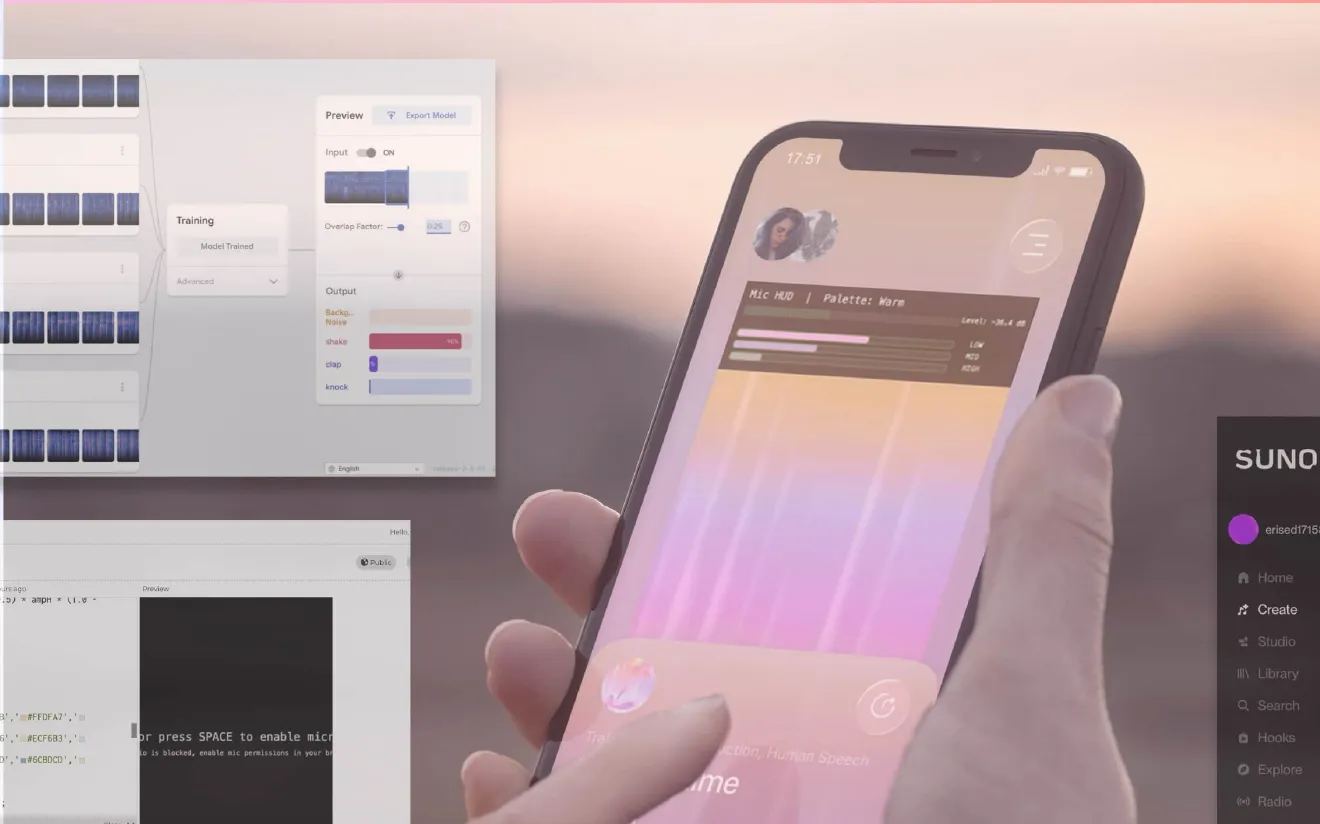
Project context
Overview
EchoBloom began with a familiar commute problem: traffic, crowds, and mechanical noise accumulate into irritation before the day has properly started. Instead of designing another noise-blocking tool, I explored whether those unwanted sounds could become raw material for something personal.
The concept records a short sound, recognizes its likely category, transforms the result into music and motion, and saves that output as a small memory of a specific place and time.
Research direction
Key Insight
The opportunity was not to make the commute silent. Silence would erase the context that made each moment distinct. The more interesting direction was to give the user authorship over the same stimulus that had been wearing them down.
A frustrating sound can become meaningful when the user can identify it, transform it, and keep the result.
What shaped the work
Design Decisions
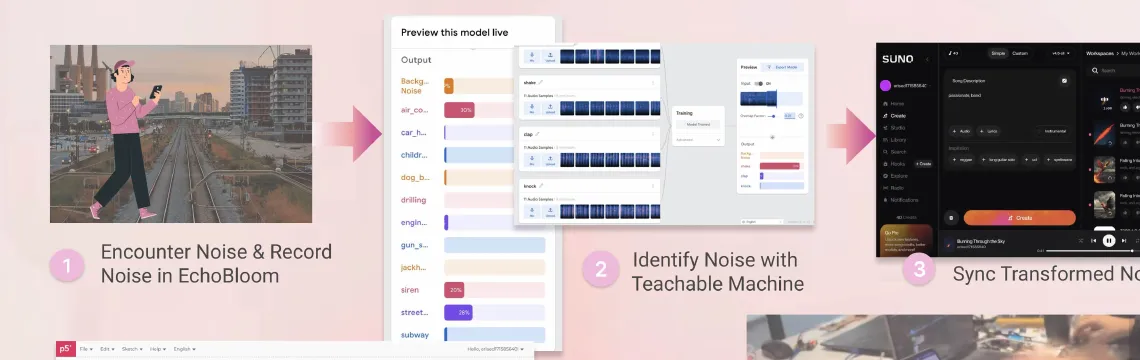
I organized the experience around one short, explainable chain rather than a feature-heavy music app. Teachable Machine and the UrbanSound8K categories provided a rough sound label; Suno supported musical exploration; p5.js translated the result into color and motion.
Process
Capture a brief fragment from the user’s current environment.
Classify the dominant noise pattern and expose the result.
Use the label as a prompt and map audio properties into motion.
Save the music-and-visual pair as a personal commute artifact.
How it works
Prototype & Experience
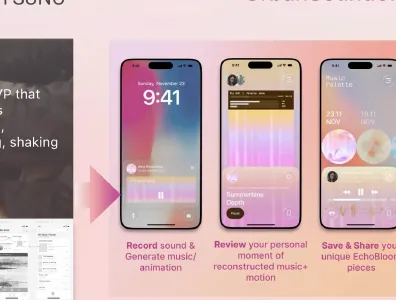
The mobile flow was reduced to three moments: record and generate, review the reconstructed music with reactive motion, then save or share the result. The visual layer intentionally feels atmospheric rather than analytical; model status and controls remain secondary to the emotional payoff.
What changed
Outcome & Reflection
The prototype proves the creative loop, but it does not yet establish robust real-world sound recognition or seamless generation latency. A production version would need clearer consent around environmental recording, graceful handling of uncertain classifications, and a faster preview before full music generation.